
Fertilizer is a useful tool for lawn maintenance, but not a universal fix to all unhealthy lawns. Fertilizer helps supplement soil nutrients. Other problems, such as soil compaction or a pH imbalance, will not be remedied by fertilizer. The key to using fertilizer successfully in your lawn is knowing what it will fix, what it won’t, and how to use it!
- First, identify areas where the grass is clearly doing poorly. Grass will always do poorly and require high maintenance under the shade of mature trees or in poorly draining soils. Consider removing grass in these poor areas and planting a garden of native shrubs and perennials more suited to the site conditions. The removal and replacement of the grass can be done in stages.
- Second, determine the pH and compaction of your soil. Both are good determiners of the nutrient levels of the soil. Applying chemical fertilizers and pesticides will not fix the soil, it will only supplement it. Just like in a vegetable garden, the nutrient level in soil needs to be improved to support the plants.
Test the pH of your soil
Soils in Western Washington are naturally acidic (under 7 on the pH scale). Turf grasses prefer a pH between 5.5 and 7. If the pH of your soil is above 5.5, there is no need to add lime. According to a WSU fact sheet The Role of Lime in Turf Management, “The most important role of lime is to maintain pH between 5.5 and 7.0, which is the most favorable range for” microbial activity in soil that makes nutrients available for plants.
Fertilizing the lawn is complicated. This is why fertilizer companies have developed general use “recipe” type products. Using these products bypasses knowing your soil needs as well as improving the soil. It’s best to learn your soil’s fertilizing needs with a soil test, improve your soil with aeration and the addition of fine compost and over-seeding, and, if needed, apply a slow-release type fertilizer according to the recommendations from the soil test.
TIP: Get a soil test done from Thurston Conservation District (360-754-3588) or Black Lake Organics (360-786-0537). For a small fee, you will receive a comprehensive analysis.
Check for soil compaction
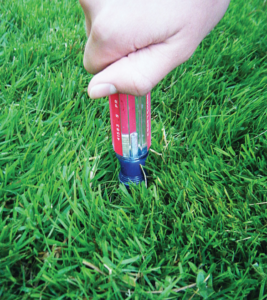
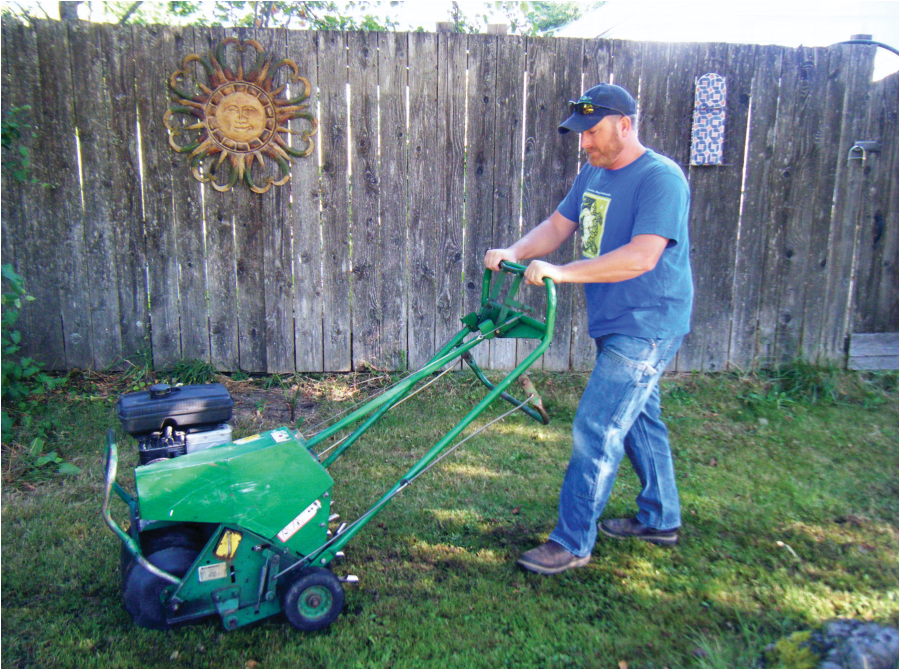
Can you easily push a screwdriver into the ground without pounding? If not, your soil is compacted and this keeps air, water and nutrients from entering the soil. Compacted soils have less microbial activity. Grass grown in compacted soils has shallower roots, more thatch and is generally weaker. If your soil is compacted, use a hand corer or mechanical aerator to punch holes through the grass and into the soil.
Tip: Check with your city/county stormwater utility. They may offer a lawn aerator rental program for residents.
How to Understand a Fertilizer Label
The three numbers on the fertilizer label represent the N-P-K ratio. The numbers are always in the same order and represent the percentage of nitrogen, phosphorus and potassium in the fertilizer.
- N-Nitrogen promotes strong leaf growth
- P-Phosphorous encourages roots, flowers, seeds and fruit
- K-Potassium is critical for overall plant health
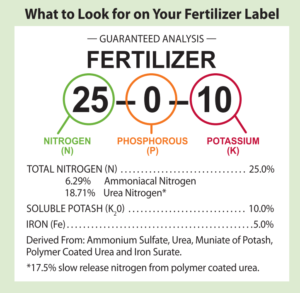
Quick-release fertilizers are typically labeled with larger numbers such as 29-2-3 or 18-16-10. They release all the nitrogen. These fertilizers are made with ammonium sulfate, urea and ammonium nitrate. Very small amounts of this type of fertilizer is needed, and it’s tricky to spread a little amount of fertilizer over a large area. Over-fertilizing with quick-release fertilizers is common. Because quick-release fertilizer is highly soluble, over-fertilizing can burn the grass, cause plant stress, and pest/disease problems. It can also create polluted runoff that harms our rivers, streams, lakes and groundwater.
Always use a properly calibrated fertilizer spreader and avoid getting fertilizer on sidewalks, driveways and the road. Sweep up and throw away any fertilizer that spills onto pavement.
Slow-release fertilizers are an excellent alternative to avoid these pitfalls. Slow-release fertilizers can be natural or organic fertilizers, or “coated” chemical fertilizers that are gradually released. Look for at least 50% insoluble nitrogen on the label. Fall fertilization will encourage deep root growth, so look for equal ratios of N and K, such as 6:1:6. (Potassium [K] encourages root growth.) Apply no more than 1 pound of nitrogen per 1,000 square feet per application. Check the weather and apply before a light rain.
Watering deeply once per week, fertilizing lightly and infrequently, aerating annually, avoiding chemicals and using a higher mow deck setting are all practices to follow to keep thatch at a healthy level.
Insect, disease, or weed control fertilizers should be avoided for the health of you, your yard, and the surrounding environment. These products allow broad application of herbicides and/or pesticides all over your yard. These chemicals can kill the beneficial micro-organisms that help create healthy soil. Spot treatment, whether by hand pulling or an appropriate herbicide, is more effective, cheaper and less polluting. In addition, some weed products contain herbicides or pesticides that target species that are not even present in the Pacific Northwest. These are a waste of money as well as potentially harmful.
Spot treating and hand-pulling weeds is a more effective and healthier way of dealing with weeds in your yard.
What’s the problem with excess nutrients?
Excess nutrients can be carried into local streams, lakes, the Salish Sea, or even our drinking water. Too much phosphorous causes algae blooms, which can result in low dissolved oxygen levels and suffocation of fish and other aquatic organisms. That’s right, the excess fertilizer that runs off lawns is harmful to our salmon populations.
An excess of nitrates in drinking water can be harmful to people, especially infants. Rain or irrigation water can carry nitrates down through the soil into groundwater. Municipal drinking water is regularly monitored for nitrates, but shallow drinking water wells are especially susceptible to nitrate contamination.
Fertilizer recommendation from Washington State University:
- 1 x per year: Sept.,
- 2 x per year: Sept. & June,
- 4 x per year: Sept., June, April & Nov.
Tip: Check with your city/county stormwater utility. They may offer a lawn aerator rental program for residents.
Help Salmon: 7 Chemicals to Avoid
| Chemical | Common Uses / Products |
|---|---|
| 2,4-D | Broadleaf weed killer, used in “weed & feed” type products |
| Carbaryl | Sevin insecticides, any combination slug/insect baits |
| Diazinon | Insecticide |
| Diuron | Direx herbicide |
| Malathion | Malathion insect sprays |
| Trifluralin | Preen herbicide |
| Triclopyr BEE | Crossbow herbicide |
By law, retailers selling pesticides and fertilizers containing these chemicals must display salmon warning information. Some stores and distributors have not complied with the court order, so it is important for you to know your chemicals.
For help finding safer options for lawn and garden products, visit: growsmartgrowsafe.org