
An Emerging Problem
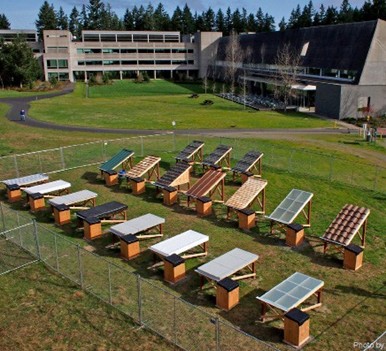
In 2011, the Washington State Department of Ecology (Ecology) worked to investigate sources of toxic pollution entering the Salish Sea. They found that roofing materials may be sources of arsenic, cadmium, and phthalates but wanted to know more about how our regional weather patterns might affect the release of contaminants from roofing materials. The Environmental Protection Agency (EPA) funded Ecology to conduct a pilot project from 2012 to 2014 to look closely at roofing material types in the Salish Sea region. In 2016, the Washington Stormwater Center continued and expanded upon the previous study. Their findings were that:
Residential and commercial roofs leach a significant amount of zinc, arsenic, and copper, some of which eventually finds its way into the Salish Sea.
The Study
- 18 4’x8’ pilot scale roof panels were constructed
- Samples of runoff were collected from 26 rain events
- Samples were analyzed for 5 different metals, specific organic compounds, and certain manufactured chemicals—all of which are known to damage human health and the natural environment.
The Findings
The original 2011 study found that the following roofing materials released the highest levels of target pollutants:
- Treated wood shakes
- Copper
- Polyvinyl Chloride (PVC)
- Zincalume (aluminum zinc alloy sheet metal roofing)
- Ethylene propylene diene monomer EPDM (rubberized single ply)
It also found that after one year of aging, metal roofs began leaching less pollutants.
What We Know
Residential roofs leach a significant amount of arsenic and copper, and commercial roofs leach a significant amount of zinc. Treated wood shakes are the primary source of arsenic. More long-term studies are needed to understand how age affects what a roof leaches. As roofing materials continue to age, concentrations of pollutants released may change over 10 or 20 years.
So What’s The Problem?
Pollutants such as arsenic, copper, and zinc can be lethal to aquatic life including our local salmon and shellfish populations. These pollutants are picked up by rain and precipitation as it flows across yards, roads, and hard surfaces before finding its way to a storm drain or directly into the nearest body of water. The roofs of every building leach pollutants that are not all captured and treated before entering local waterways. Collectively, our roofs are contributing to the pollution of the Salish Sea, so what are people doing about it?
Green Roofs
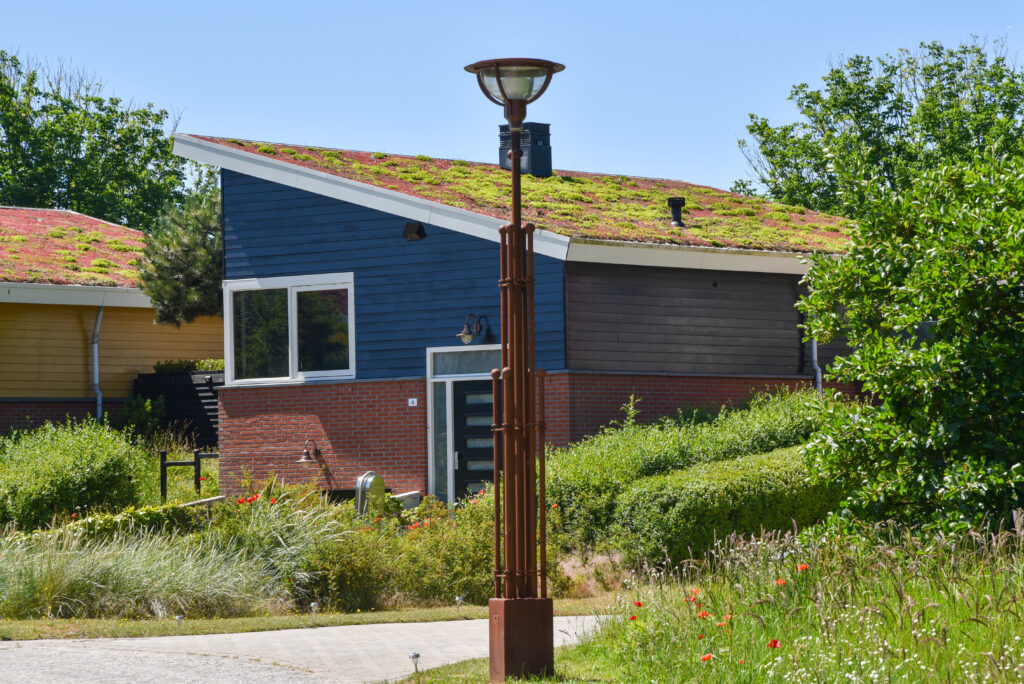
Green roofs, also known as eco-roofs, vegetated roofs or living roofs, are one solution that is gaining traction. They capture both the literal and environmental meanings of the word green. Vegetation is installed over several underlayments (layers of material) create a roof that is literally alive. Green roofs can be installed on roof pitches ranging from 5° to 40°. Green roofs treat pollution in stormwater and also store a significant amount of water, further preventing polluted stormwater runoff from entering our waterways and combined sewer systems.
In Germany, it is estimated that green roofs already comprise 12% of flat roofs. In Copenhagen, Denmark it is mandatory that all flat roofs under a 30° pitch be vegetated. Here in the Pacific Northwest, new low impact development regulations to help control stormwater and the encouragement of public utilities, have boosted green roof installation.
Some of the many ecological benefits of green roofs include:
Energy use reduction
During an 80°F summer day, a black roof can reach 180°F. Plant covered roofs typically can only reach 85°F. During the winter, a green roof will retain 15-30% more heat than a conventional roof. This insulation translates into lower cooling and heating costs! (Lui & Baskaran 2003, National Research Council of Canada)
Urban heat island reduction
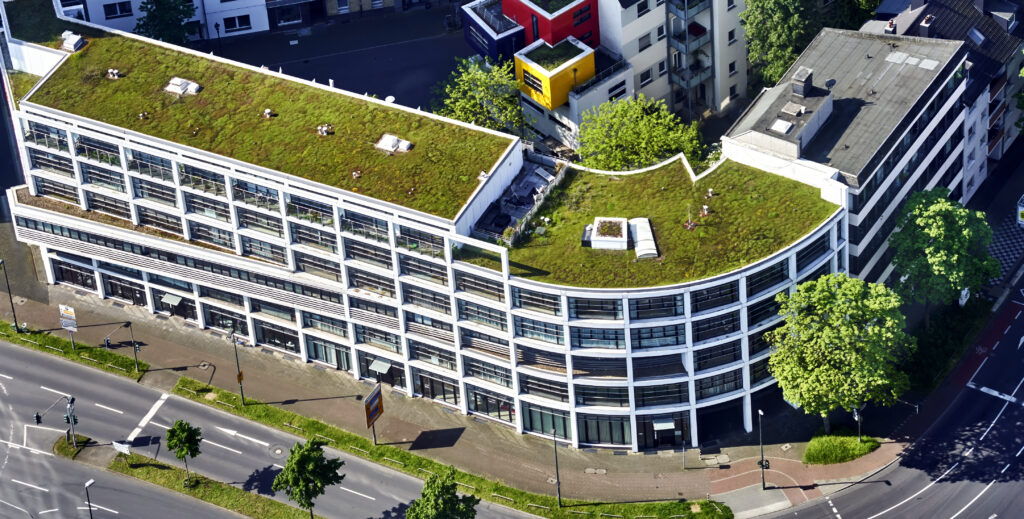
The more green roofs in an urban area, the lower the ambient temperature of the city.
Greenhouse effect mitigation
Green roofs radiate less energy than black roofs into the atmosphere. A University of California at Berkeley lab study found that switching to “cool” or “white” roofs alone would be the equivalent of removing 300 cars from the roads for 20 years.
Air quality improvement and carbon sequestration
Photosynthesis removes carbon from the atmosphere and stores it as biomass.
Added habitat
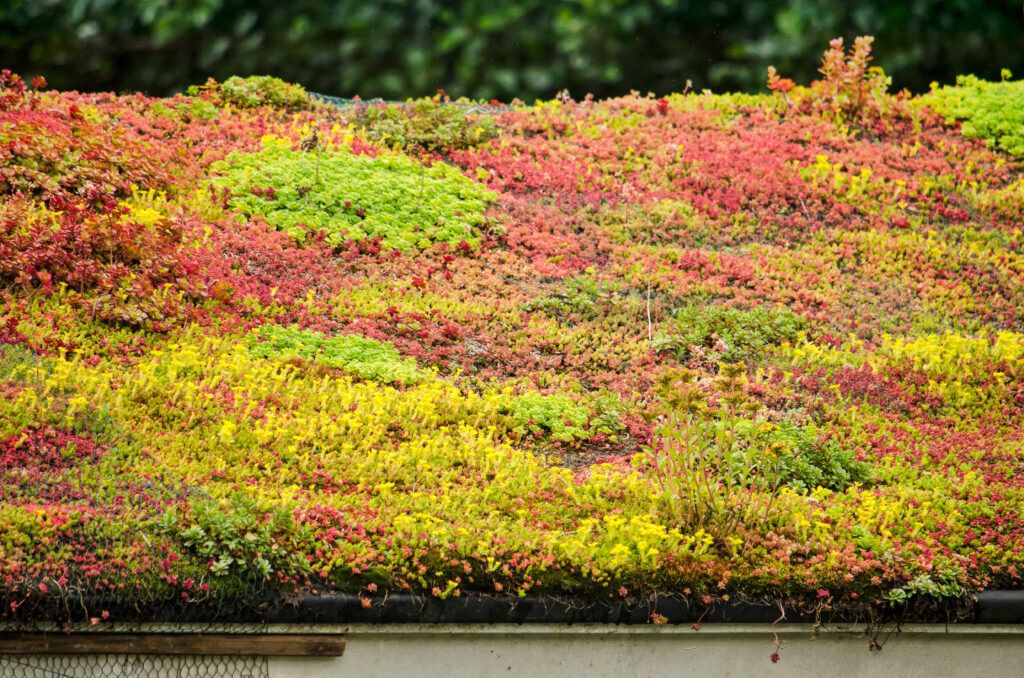
Native vegetation attracts butterflies, birds and bees.
Sound proofing
Outside noise can be reduced from between 40-50 decibels depending on the type of green roof. (Peck et al. 1999)
Less waste
According to research, a green roof will lengthen roof life by up to 20 years. (Miller, C. 1998)
Stormwater treatment
Green roofs reduce the amount of stormwater runoff and also delay the time at which runoff occurs, resulting in decreased stress on stormwater and combined sewer systems at peak flow periods.
Green roofs can be designed and engineered in two ways. The initial investment pays off in terms of reduced energy costs and the increased longevity of the roof:
Intensive roofs
These roofs require a flat surface and are well suited to public or private businesses that want to encourage roof-top gardening and/or a park-like setting. A deep substrate of 8-24 inches of soil is able to accommodate lawns, edible crops, small trees and shrubs. This high load (35-120 lbs. per square foot) requires additional structural support to increase load-bearing capacity. Because of their increased weight and the possible need to add an irrigation system, these roofs have a higher capital cost. They also have higher maintenance requirements. Cost of installing an intensive green roof begins at $25 a square foot.
Extensive roofs
These roofs generally weigh 10-50 lbs. per square foot and are within the load bearing capacity of a typical roof. They are suitable for home or business owners who want a self-sustaining roof that requires low to no-maintenance. The planting substrate is shallow, containing four to six inches of engineered soil mix and best accommodates low-growing, fire resistant, drought-tolerate vegetation such as local wildflower mixes, sedums, herbs, mosses and grasses, typically on a 5-20° pitch. It costs approximately $10-24 per square foot to install an extensive green roof with root repellant/waterproof membranes and other key underlayments.
Components of a green roof will vary depending on the type and size of installation as well as the manufacturer. A waterproofing membrane is critical if the system is going to succeed in the long-term. However, several layers of other protective materials are often included to achieve waterproofing and to convey water away from the roof deck. The following diagram illustrates the possible components:
SPOTLIGHT ON LOCAL PROJECTS
Interested in seeing some green roofs in person? Here is a partial list of green roofs that you can visit:
OLYMPIA:
The Evergreen State College: Seminar II Bldg, 2700 Evergreen Pkwy NW, 98505 Type: Extensive | Year: 2004
Woodland Trail Restroom, 1600 Eastside Street SE, 98501 Type: Extensive | Year: 2007
Olympia City Hall, 601 4th Ave E, 98501 Type: Extensive | Year: 2011
SEATTLE:
Russell Investments Center, 1301 Second Avenue, 18th Floor, 98101 Type: Intensive | Year: 2006
PORTLAND:
Multnomah County Multnomah Bldg, 501 SE Hawthorne Blvd., 97214 Type: Extensive | Year: 2003
Oregon Health & Science University (OHSU) Center for Health & Healing, 3303 SW Bond Ave., 97239 Type: Extensive & Intensive | Year: 2006
Thank you to Lisa Rozmyn, the Washington Stormwater Center & Washington State University for providing access to the research materials and studies that can be found at wastormwatercenter.org.
Source: Stream Team News, Winter 2014