
Mulch mowing or “grasscycling” is a no cost lawn care routine that naturally fertilizes your lawn as you mow. Mulch mowing can save you time, energy and money while helping to keep your lawn healthy and green!
Mulch mowers are specially designed to shred grass finely and blow the clippings back down into the turf, leaving no visible residue or grass to track into the house. They also yield a “green lawn” by leaving a layer of nutrients that will seep back into your soil. The amount of nitrogen that releases back into your lawn almost equals the recommended value of fertilizer. The next time you are in the market for a new mower, consider purchasing a mulching variety, available in gas or electric models at a variety of prices.
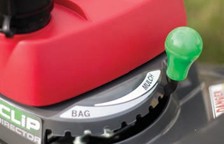
You can also use your conventional mower as a mulch mower by removing the bag from the rear and covering the discharge chute, or using the side-discharge to uniformly spray the clippings in a pattern that distributes them evenly on your lawn. (Some mower brands sell mulch mower adaptor kits that will help cut the grass blades into smaller pieces.) A push mower is another alternative that has the advantage of being a great form of exercise, while distributing grass clippings evenly. The disadvantage of these mowers is that the grass will not be shred as finely or blown back into the turf, but you can always mow over the larger clumps or rake them to use in compost or as mulch on garden beds.
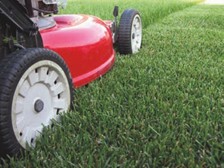
To reduce stress on your lawn, it is best to only cut 1/3 of the grass blade at a time. In the spring, this probably equates to mowing once a week.
During the summer, it may decrease to once every two weeks. Remember that cutting too much at once stresses the grass. If you want your lawn to be 2 inches tall, mow it when the grass grows to be 3 inches tall. If your lawn has grown 4 inches, set your mower to 3 inches and mow. Wait two days and lower your blades to 2 inches and mow again. As long as you maintain this “2/3 system” the top inch of grass will decompose rapidly allowing for optimum lawn health and accounting for up to 1/2 of your fertilizing needs.
For best results, keep the blade(s) on your mower in optimal condition by sharpening twice a year. Mow when it is dry, slowing down when going through overgrown patches.
Contrary to popular belief, mulch mowing does not contribute to thatch problems. Thatch is comprised of grass leaves, stems and roots. It is found above the soil surface and is a natural part of your lawn. Thatch is beneficial to your lawn unless it gets thicker than ½ – ¾ inches deep.
Now, relax! No need to rake or dispose of grass clippings. You’ve kept your grass clippings out of the waste stream and from overloading the compost facility. You’ve saved money on your water bill and you’ve reduced your lawn’s need for fertilizer! Mulch mowing helps improve the health of your lawn and the environment at large.
Source: Stream Team News, Summer 2014